


Beauty Tips Well Health Organic for Natural Skin Care
Natural beauty care often starts with simple habits, including gentle cleansing, regular moisturizing, sun protection and choosing skincare products that suit your skin type. Many traditional South Asian beauty practices also use ingredients such as aloe vera, turmeric, rose water and gram flour.
This guide to Beauty Tips Well Health Organic discusses traditional skincare ideas alongside practical, evidence-informed beauty advice. It explains how to build a simple daily skincare routine, understand common natural ingredients, care for your hair and avoid remedies that may irritate your skin.
Rather than assuming that every natural ingredient works for everyone, the focus is on understanding its potential uses, limitations and precautions. This makes it easier to choose beauty habits that fit your skin’s needs.
The Basic Principles of a Natural Skincare Routine
Natural beauty care focuses on simple habits and ingredients that suit your skin. Traditional South Asian skincare often includes aloe vera, turmeric, rose water and gram flour. However, natural ingredients are not automatically safe or suitable for everyone.
A practical skincare routine should focus on these six principles:
| Principle | Practical approach |
|---|---|
| Gentle cleansing | Use a mild cleanser to remove dirt and excess oil. |
| Moisturizing | Choose a moisturizer suited to your skin type. |
| Sun protection | Apply broad-spectrum SPF 30 or higher sunscreen. |
| Ingredient awareness | Check ingredients and patch-test new products. |
| Healthy habits | Maintain a balanced diet and get adequate sleep. |
| Consistency | Follow a simple routine instead of frequently changing products. |
These habits can help maintain healthy-looking skin. Remember that traditional remedies are not proven treatments for every skin concern. Avoid ingredients that cause irritation and consult a dermatologist for persistent acne, rashes or pigmentation.
Step One: Identify Your Skin Type
Understanding your skin type helps you choose suitable skincare products and build a routine that meets your skin’s needs. Most people can identify their skin as dry, oily, combination or sensitive, although skin conditions and sensitivity can change over time.
Ayurveda also describes three traditional doshas: Vata, Pitta and Kapha. These concepts are part of traditional Ayurvedic practice, rather than medically established skin classifications.
Vata: Traditionally Associated with Dry Skin
In Ayurveda, Vata is associated with dryness and roughness. People who identify with this traditional category may prefer gentle cleansers and moisturizing skincare products.
Pitta: Traditionally Associated with Sensitive Skin
Pitta is traditionally linked with heat and sensitivity. A gentle skincare routine and products without irritating ingredients may be suitable for people with easily irritated skin.
Kapha: Traditionally Associated with Oily Skin
Kapha is traditionally associated with oiliness and heaviness. People with oily skin may prefer lightweight, non-comedogenic moisturizers and gentle cleansers.
Remember: These Ayurvedic descriptions are traditional wellness concepts, not medical diagnoses. Choose skincare products according to your actual skin type and concerns rather than relying solely on dosha classifications.
Complete Daily Skin Care in Hindi WellHealthOrganic Style — Step by Step

This is the definitive daily routine inspired by the WellHealthOrganic framework, with Hindi names for each step for easy reference and sharing.
| Time | Step (Hindi) | What to Do | Best For |
| Morning | सफाई (Safai — Cleansing) | Splash face with cold water or use raw milk on cotton pad. Never use face wash in the morning unless you have very oily skin — overnight sebum is your skin’s natural moisturizer. | All skin types |
| Morning | टोनिंग (Toning) | Apply fresh rose water (गुलाब जल) with palms or cotton — no wiping, just gentle patting. Or use chilled green tea as a Pitta-calming alternative. | All; green tea best for Pitta |
| Morning | नमी (Nami — Moisturizing) | Vata: 3–4 drops almond oil patted in. Pitta: aloe vera gel. Kapha: lightweight rose hip gel or nothing in monsoon. | Dosha-specific |
| Morning | सुरक्षा (Suraksha — Sun Protection) | SPF 30–50 mineral sunscreen if going outdoors. Ayurvedic alternative: red raspberry seed oil (natural SPF ~28–50). Kumkumadi tailam also provides mild UV protection. | All, especially Pitta |
| Evening | दोहरी सफाई (Double Cleanse) | Step 1: Warm coconut or sesame oil massage to dissolve SPF and pollution particles (2 min). Step 2: Besan (gram flour) paste or gentle cleanser with rose water to remove oil residue. | All, especially Kapha |
| Evening | उपचार (Upchar — Treatment) | Bakuchiol oil (natural retinol alternative) for anti-aging. Neem oil diluted 1:10 in jojoba for active acne. Rosehip oil for dark spots. Apply only to concerns, not all over. | Targeted, per concern |
| Night | रात्रि पोषण (Night Nourishment) | Vata: sesame oil. Pitta: chamomile or sandalwood face oil. Kapha: pure aloe vera overnight. Apply to slightly damp skin for maximum absorption. Less is more. | Dosha-specific |
Hindi Summary — Daily Skin Routine (रोज़ाना स्किन केयर)
सुबह: ठंडे पानी से सफाई → गुलाब जल से टोनिंग → त्वचा के अनुसार मॉइस्चराइजर → सनस्क्रीन। रात: तेल से डबल क्लेंज → उपचार → रात्रि पोषण। बस इतना काफी है — बाकी सब मार्केटिंग है।
20 Ayurvedic Ingredients — Beauty Tips – Well Health Organic.com Decoded
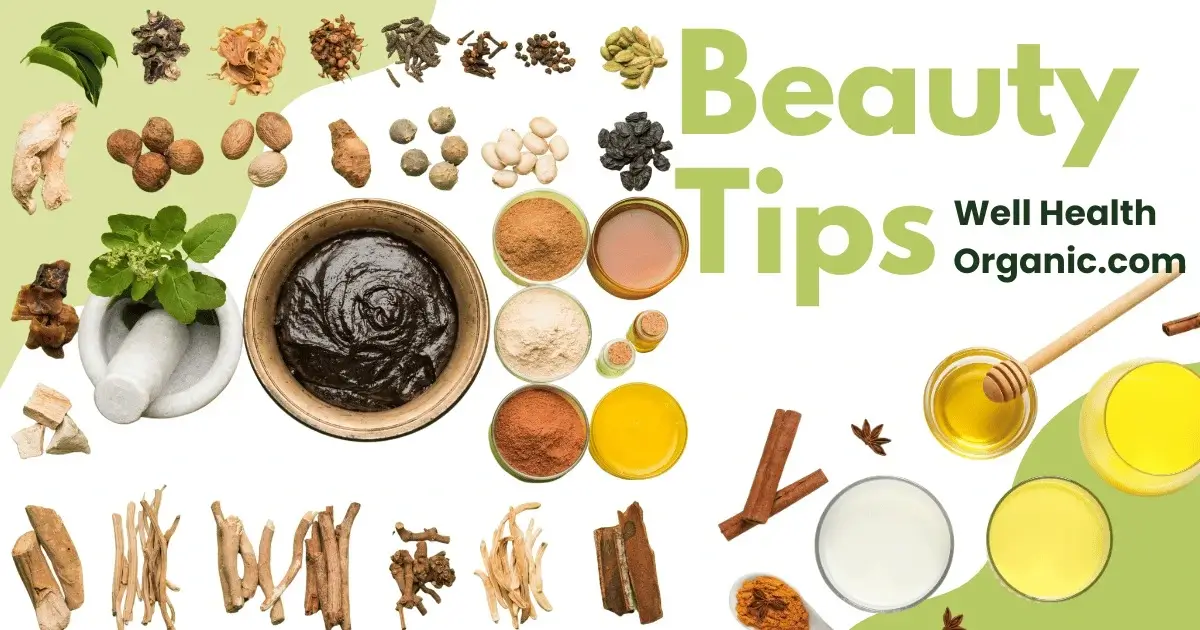
Every beauty tip from Well Health Organic ultimately comes back to these foundational ingredients. Here is the most complete, evidence-annotated reference table available for these ingredients in 2026:
| Ingredient (Hindi) | Active Compounds | Primary Skin Benefit | How to Use | Dosha |
| Turmeric (हल्दी) | Curcumin | Anti-inflammatory, brightens hyperpigmentation, antibacterial for acne | ¼ tsp in face pack; pair with honey to prevent yellow staining | Pitta Kapha |
| Sandalwood (चंदन) | Alpha-santalol | Cooling, anti-inflammatory, reduces redness and prickly heat | Paste with rose water; leave 15 min | Pitta |
| Neem (नीम) | Nimbin, Nimbidin | Antibacterial, antifungal — kills acne bacteria; reduces blackheads | Dilute neem oil 1:10 in carrier; neem powder in face pack | Pitta Kapha |
| Rose Water (गुलाब जल) | Phenylethanol | Tones, hydrates, reduces redness; balances skin pH to ideal 5.5 | Toner, face mist, added to face packs | All doshas |
| Aloe Vera (घृतकुमारी) | Acemannan, Aloin | Deep hydration, wound healing, sunburn repair, reduces dark circles | Fresh gel directly from plant; apply to damp skin | Pitta Vata |
| Besan (बेसन) | Saponins, Zinc | Gentle exfoliant, controls excess sebum, naturally brightens | Paste with milk (Vata) or water + turmeric (Kapha) | Kapha Pitta |
| Raw Honey (शहद) | Methylglyoxal (MGO) | Humectant (draws moisture), antibacterial, wound healing accelerator | Alone as mask 10 min; mixed with turmeric or papaya | All doshas |
| Amla (आंवला) | Emblicanin A & B | Highest natural Vitamin C; collagen stimulation; anti-aging | Fresh juice applied to face 15 min + eaten daily | All doshas |
| Coconut Oil (नारियल तेल) | Lauric acid | Antibacterial makeup remover; deep moisturizer for dry skin; scalp health | Cleansing oil; scalp massage; not recommended for Kapha acne-prone face | Vata |
| Sesame Oil (तिल का तेल) | Sesamol, Sesamolin | Natural SPF ~5, antioxidant, Vitamin E; warming; prevents premature aging | Abhyanga body massage; foot massage; winter face oil | Vata |
| Mulethi / Licorice (मुलेठी) | Glabridin | Tyrosinase inhibitor — reduces melanin production; fades dark spots; brightens | Powder in milk toner or face pack; 2–3 times weekly | All, especially Pitta |
| Fuller’s Earth (मुल्तानी मिट्टी) | Smectite clay minerals | Deep pore cleansing, oil absorption, reduces blackheads, cools skin | Mix with rose water; 10–15 min weekly; do not over-dry | Kapha |
| Papaya (पपीता) | Papain enzyme | Natural exfoliation, skin brightening, removes dead cells, reduces scars | Raw papaya paste 15 min; ripe papaya for sensitive skin | All, especially dull skin |
| Saffron (केसर) | Crocin, Safranal | Brightens complexion, reduces hyperpigmentation; antioxidant-rich | 2–3 strands soaked in milk overnight; apply soaked milk to face | All doshas |
| Kesar + Milk (केसर दूध) | Crocin + Lactic acid | Combined brightening, exfoliation; traditional bridal glow remedy | Soaked saffron milk applied to face 20 min, 3x weekly | All doshas |
| Fenugreek (मेथी) | Diosgenin | Stimulates hair follicles; reduces dandruff; improves scalp circulation | Soaked overnight; ground into paste; apply to scalp 30 min | Vata Kapha |
| Green Tea (हरी चाय) | EGCG (Epigallocatechin) | Powerful antioxidant; reduces UV-induced skin damage; calms redness | Cooled brewed tea as toner; used tea bags on eyes | Pitta |
| Manjistha (मंजिष्ठा) | Purpurin, Munjistin | Blood purifier → clearer skin; reduces pigmentation; lymphatic support | Powder in face pack or internal supplement (consult practitioner) | Pitta |
| Kalonji (कलौंजी) | Thymoquinone | Potent anti-inflammatory; acne, eczema, psoriasis reduction | 2–3 drops kalonji oil diluted in 1 tsp jojoba; spot treatment | Pitta Kapha |
| Hibiscus (गुड़हल) | Alpha-hydroxy acids (natural AHAs) | Natural chemical exfoliant; reduces fine lines; tightens pores | Dried petal powder in face pack; hibiscus-infused oil for hair | All doshas |
7 DIY Face Pack Recipes — Skin Care in Hindi WellHealthOrganic Style
Recipe 1: Glowing Bride Pack (दुल्हन निखार पैक)
Pitta Vata — Best for dull, uneven skin
- 1 tbsp besan (gram flour)
- ¼ tsp turmeric (raw, not processed)
- 1 tsp raw honey
- 2 tbsp fresh milk (full-fat)
- 3 drops rose water
Mix to smooth paste. Apply to face and neck. Leave 15–20 min until just dry. Rinse with lukewarm water using gentle circular motions. Use 2–3 times weekly for 4 weeks for measurable brightening.
Hindi
बेसन, हल्दी, शहद और दूध मिलाकर पेस्ट बनाएं। चेहरे पर 15-20 मिनट लगाएं। सप्ताह में 3 बार। 4 हफ्तों में निखार दिखेगा।
Recipe 2: Anti-Acne Neem Pack (मुहांसों के लिए नीम पैक)
Kapha Pitta — Best for acne, blackheads, oily skin
- 1 tbsp neem powder (or 8 fresh neem leaves, ground)
- 1 tbsp multani mitti (Fuller’s earth)
- 1 tsp lemon juice (omit for very sensitive skin)
- Rose water to bind
Apply to affected areas only — not all over face if skin is dry elsewhere. Leave 10 min maximum. Rinse and follow with aloe vera gel as a light moisturizer. Once weekly.
⚠ Do not leave neem pack longer than 12 minutes — extended contact can cause dryness and irritation on sensitive skin.
Recipe 3: Winter Deep Moisture Pack (सर्दियों का मॉइस्चर पैक)
Vata — Best for dry, flaky, winter-dehydrated skin
- 1 tbsp ripe banana (mashed)
- 1 tsp raw honey
- ½ tsp cold-pressed almond oil
- 1 tsp malai (milk cream) or full-fat yogurt
Apply to clean, slightly damp skin. Leave 20 minutes. Rinse with cold water. Particularly effective after a hot shower when pores are open. Twice weekly in winter months.
Recipe 4: Papaya Enzyme Brightening Pack (पपीता एंजाइम पैक)
All skin types — Best for dullness, uneven tone, post-acne marks
- 2 tbsp raw (unripe) papaya pulp — papain concentration is highest in unripe papaya
- ½ tsp turmeric
- 1 tsp raw honey
Apply to face and neck, avoiding eye area. Leave 10–12 minutes only — the papain enzyme is active and prolonged contact can over-exfoliate. Rinse well. Once weekly maximum.
Recipe 5: Saffron Glow Pack (केसर चमक पैक)
All doshas — Best for special occasions, bridal prep, overall radiance
- 4–5 saffron strands soaked overnight in 2 tbsp full-fat milk
- 1 tsp sandalwood powder (चंदन)
- ½ tsp mulethi powder
- Rose water to adjust consistency
This is the original Mughal beauty remedy. Apply for 20 min, 3 times a week for 3 weeks before a major event. The combination of saffron’s crocin, sandalwood’s cooling, and mulethi’s tyrosinase inhibition creates a synergistic brightening effect documented in traditional Unani medicine.
Recipe 6: Pore-Minimizing Green Tea Mask (हरी चाय छिद्र पैक)
Pitta Kapha — Best for large pores, oily T-zone, redness
- 2 tsp cooled green tea (strongly brewed)
- 1 tbsp kaolin clay or multani mitti
- 3 drops tea tree oil (diluted in 1 tsp jojoba first)
Mix to a spreadable consistency. Apply to T-zone or full face. Leave 10 minutes. EGCG in green tea combined with clay creates a pore-refining treatment with strong clinical evidence for sebum reduction.
Recipe 7: Hair Mask for Scalp Health (बालों का आयुर्वेदिक हेयर मास्क)
All hair types — best for thinning, dull, or dandruff-prone hair
- 2 tbsp bhringraj powder or bhringraj-infused oil
- 1 tbsp amla powder
- 2 tbsp curd (fresh, homemade)
- 1 tsp fenugreek powder (soaked overnight, ground)
Apply from scalp to ends. Cover with warm towel (steaming effect). Leave 45–60 minutes. Rinse with mild shampoo. Once weekly for 8 weeks. Bhringraj’s eclipta alba compounds are clinically shown to significantly stimulate hair follicle growth cycles.
Full Body Organic Skin Care — Beyond the Face
One area where WellHealthOrganic beauty content is particularly weak is full-body care. The face gets 95% of the attention; the body gets a footnote. ProThots corrects this imbalance:
| Body Area | Common Concern | Organic Well Health Solution | Frequency |
| Neck and décolletage | Darkening, sagging, tech neck | Upward strokes with saffron milk; kumkumadi tailam applied nightly with upward massage | Nightly |
| Hands | Dryness, dark knuckles, cracked cuticles | Coconut oil + sugar scrub weekly; pure shea or kokum butter overnight gloves | Weekly scrub; nightly moisture |
| Elbows and knees | Hyperpigmentation, roughness | Lemon + coconut oil applied for 10 min before bathing; besan exfoliation | 3–4 times weekly |
| Feet and heels | Cracked heels, dryness | Warm water + rock salt soak (10 min); pumice stone; pure sesame oil massage; cotton socks overnight | 2–3 times weekly |
| Underarms | Darkening, sensitivity | Potato slice (natural azelaic acid) applied 10 min; avoid chemical deodorants; natural alum stone | Daily potato; alum daily |
| Full body | Dull, ashy, uneven tone | Ubtan (besan + turmeric + milk) full-body scrub before bathing; abhyanga with sesame oil | Weekly ubtan; pre-bath oil daily |
The Diet-Skin Connection: What You Eat Shows on Your Face
The most comprehensive beauty tips from Well Health Organic always circle back to internal health. Here are the specific dietary interventions with the strongest dermatological evidence for skin improvement:
The Single Most Impactful Diet Change for Skin
Eliminating high-glycemic foods (white rice, refined sugar, maida-based foods, packaged biscuits) for 6–8 weeks produces measurable reductions in acne severity in over 60% of participants across multiple randomized controlled trials. This works because high-glycemic foods spike insulin → trigger androgen production → increase sebum → clog pores. No face pack addresses this cycle; dietary change does.
| Skin Concern | Add to Diet | Remove / Reduce | Timeline for Results |
| Acne | Zinc-rich foods (pumpkin seeds, chickpeas), probiotics (curd, kanji), spearmint tea | Dairy milk (not curd), refined sugar, whey protein | 3–6 weeks |
| Dullness/Uneven tone | Vitamin C foods (amla, guava, capsicum), beet juice, saffron milk | Alcohol, smoking, white bread | 4–8 weeks |
| Premature aging | Omega-3s (flax, walnuts, mustard oil), green tea, pomegranate | Excess sugar (glycation destroys collagen), processed oils | 8–12 weeks |
| Dry/dehydrated skin | 3L+ water daily, healthy fats (ghee, avocado), silica (cucumber, oats) | Caffeine excess, alcohol | 1–2 weeks |
| Dark circles | Iron-rich foods (spinach, lentils, jaggery), Vitamin K (leafy greens), sleep | Salt excess (causes fluid retention under eyes), screen time past 10pm | 3–4 weeks |
Season-by-Season Organic Skincare Calendar — Skin Care in Hindi WellHealthOrganic Annual Guide
| Season | Key Skin Challenge | Priority Ingredient | Weekly Face Pack | Hindi Skin Tip |
| March–May (Vasanta/Grishma) | UV damage, oiliness beginning | Aloe vera, rose water, sandalwood | Sandalwood + rose water + multani mitti | ढेर सारा पानी पिएं; सनस्क्रीन लगाएं |
| June–August (Varsha) | Humidity, fungal issues, clogged pores | Neem, tea tree, green tea | Neem + multani mitti pack weekly | मानसून में तेल-आधारित उत्पाद कम करें |
| Sept–Oct (Sharad) | Transitional pigmentation, tan removal | Papaya, mulethi, amla | Papaya + honey brightening pack | आंवला खाना शुरू करें — निखार आएगा |
| Nov–Dec (Hemanta) | Dryness begins, barrier weakens | Sesame oil, almond oil, honey | Banana + honey + malai hydration pack | रात को बादाम तेल लगाएं और सोएं |
| Jan–Feb (Shishira) | Peak dryness, chapping, dullness | Ghee, saffron milk, sesame oil | Saffron + sandalwood + milk glow pack | गुनगुने पानी से चेहरा धोएं, ठंडे से बचें |
Frequently Asked Questions
What are beauty tips from Well Health Organic.com?
Beauty Tips – Well Health Organic.com focus on chemical-free, Ayurvedic skincare using kitchen ingredients — turmeric, aloe vera, besan, rose water, neem, and saffron — to promote naturally glowing, healthy skin across all Indian skin types and tones. The philosophy prioritizes internal health (diet, gut, sleep) as the foundation of external beauty.
How to do skin care in Hindi WellHealthOrganic style at home?
A WellHealthOrganic-style Hindi skincare routine at home: Morning — rinse with cold water, pat with rose water (गुलाब जल), apply almond oil (Vata) or aloe vera gel (Pitta/Kapha). Evening — double cleanse with coconut oil then besan paste, apply neem oil spot treatment if needed, finish with night oil suited to your dosha. Weekly — one of the seven DIY face pack recipes described in this guide based on your skin concern and season.
Which WellHealthOrganic ingredient is best for dark spots?
The three most evidence-backed natural ingredients for dark spot reduction are: mulethi (licorice / glabridin) for tyrosinase inhibition, amla (Vitamin C / collagen stimulation), and papaya enzyme (papain exfoliation). Used consistently — 3–4 times weekly in face packs — these show measurable hyperpigmentation reduction within 6–8 weeks. Add Vitamin C from amla internally for the fastest combined results.
Is turmeric safe to put on the face every day?
Daily turmeric application is not recommended because the yellow pigment can temporarily stain fair skin and fabric. Twice weekly is the optimal frequency for face pack use. Internally, turmeric is safe to consume daily when combined with black pepper (which increases bioavailability by 2,000%). For skincare, pairing turmeric with raw honey or besan in a pack reduces the staining risk significantly.
Can natural beauty tips from WellHealthOrganic work for oily skin?
Yes, and the WellHealthOrganic framework is particularly effective for oily (Kapha) skin because it addresses root causes: excess sebum is often driven by over-stripping the skin with harsh cleansers (which triggers compensatory oil production) and by high-glycemic diet. Kapha-specific recommendations — neem packs, multani mitti, green tea toner, and besan cleansing instead of soap — regulate oil without the rebound oiliness that chemical products often cause.
What is the difference between skin care in Hindi WellHealthOrganic and Korean skincare?
Korean skincare follows a 7–12 step hydration-layering protocol designed for North Asian skin types in temperate climates. WellHealthOrganic-style Indian skincare is a 4–6 step dosha-based system using Ayurvedic ingredients specifically studied and used for South Asian skin — higher melanin concentration, tropical/subtropical climate adaptation, and indigenous ingredient access. Neither is superior; the WellHealthOrganic approach is simply better aligned with Indian skin types, climate patterns, and available ingredients.

Hanna Muart is a professional makeup artist, UGC creator, and beauty blogger based in the Philadelphia, Pennsylvania area, with connections across New Jersey and New York. She shares makeup ideas, beauty product reviews, unboxings, bridal looks, and practical beauty content. Through her work as a makeup artist, Hanna brings hands-on experience and a professional perspective to the products and techniques she features.