


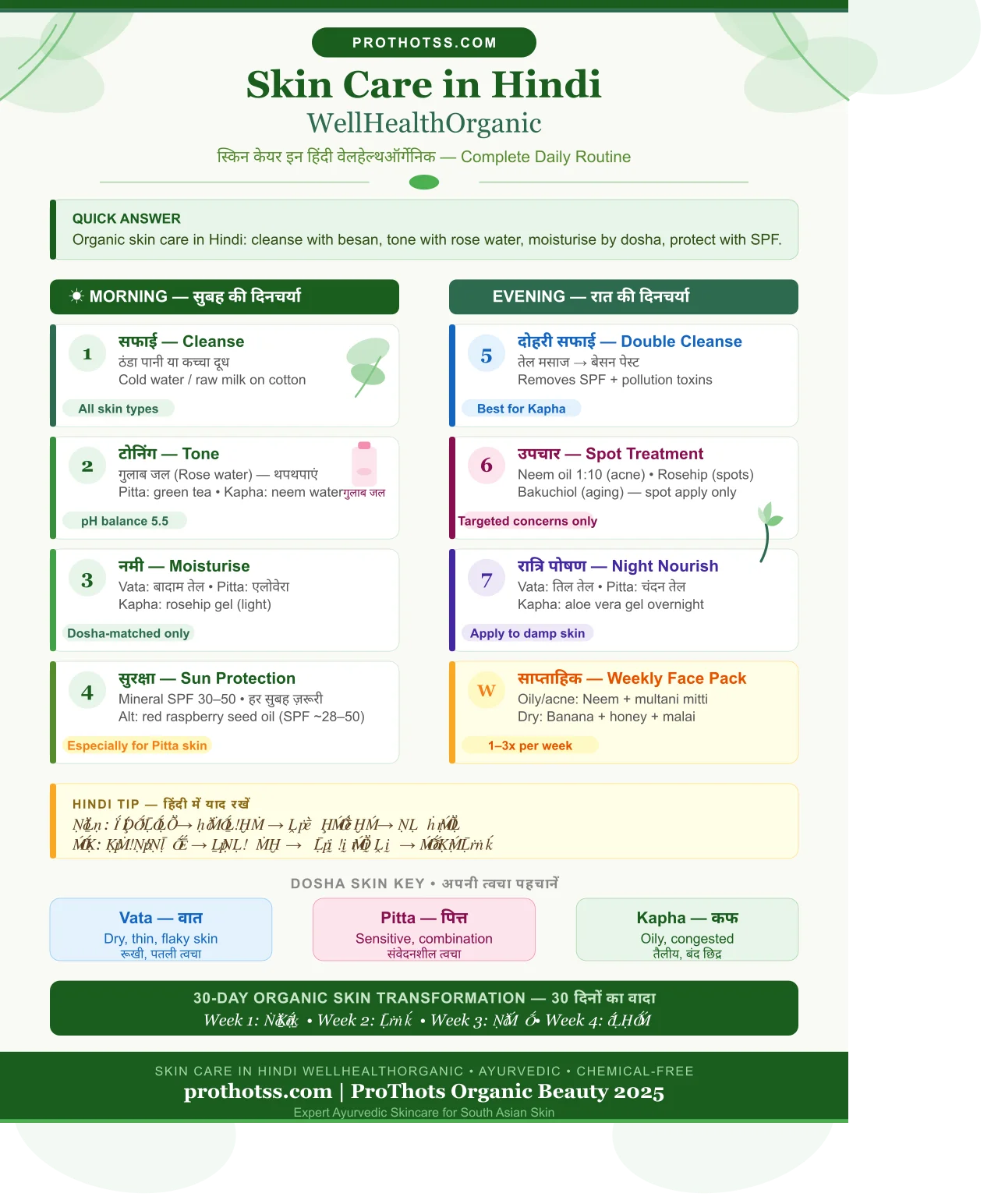
(स्किन केयर टिप्स हिंदी में — आयुर्वेदिक और घरेलू नुस्खे)
Note on this guide: people searching “skin care in Hindi WellHealthOrganic” are usually looking for Ayurvedic, chemical-free skincare guidance in Hindi — that’s the topic this article covers directly, in our own voice and with our own review process, rather than repackaging another brand’s material. This guide focuses on topical remedies; for daily lifestyle habits (diet, breathing, herbs), see our daily Ayurvedic wellness habits guide.
Why This Guide Exists
If you’ve tried five different “natural” remedies in the same week because none of them seemed to be working fast enough — you’re not alone, and that’s actually the most common reason skin gets worse rather than better. We see this pattern constantly: someone starts a besan scrub, adds a turmeric mask two days later, throws in an aloe gel because a friend swore by it, and within ten days their skin is irritated and they conclude “natural remedies don’t work.” They usually did work — there just wasn’t time for any single one to show results before it got swapped out.
Search for Hindi-language skincare advice and you’ll find dozens of near-identical articles: the same five ingredients (turmeric, neem, aloe vera, besan, rose water), the same four-step routine, and nothing that explains why any of it works or how long it actually takes. This guide goes further — skin-type identification, the mechanism behind each remedy, a seasonal (Ritucharya) calendar, the mistakes we see most often, and a 30-day plan that’s meant to be followed as written, not modified every three days.
Where a claim depends on a specific study, we link to it. Where the evidence is traditional/observational rather than clinical, we say so plainly instead of dressing it up as a controlled trial.
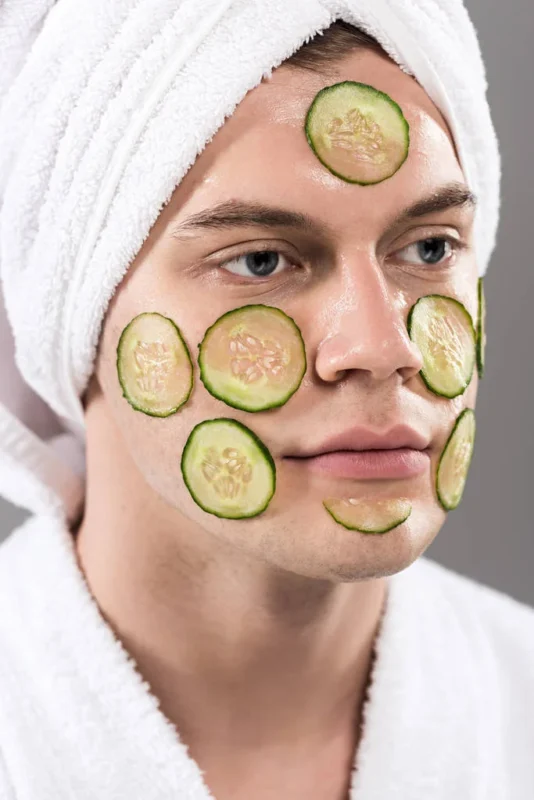
1. Identify Your Skin Type
Before using any remedy, know your skin. The Ayurvedic dosha framework and standard dermatological skin typing map onto each other well:
| Skin Type | Hindi Name | Dosha Tendency | Key Signs | Main Concerns |
|---|---|---|---|---|
| Dry | रूखी त्वचा | Vata | Flaking, tightness after washing, dullness in winter | Early fine lines, dehydration, cracked heels |
| Oily | तैलीय त्वचा | Kapha | Midday shine, enlarged pores, blackhead-prone | Acne, clogged pores, monsoon breakouts |
| Combination | मिश्रित त्वचा | Vata-Kapha / Pitta-Kapha | Oily T-zone, normal-to-dry cheeks | Uneven hydration needs |
| Sensitive | संवेदनशील त्वचा | Pitta | Redness, stinging, reacts to new products | Rosacea, sun sensitivity |
| Normal | सामान्य त्वचा | Balanced | Even texture, good elasticity | Maintenance, prevention |
30-minute self-test: Wash with plain water, pat dry, wait 30 minutes without applying anything, then check: tight/flaky → dry; shiny all over → oily; shiny T-zone only → combination; red/stinging → sensitive; comfortable and even → normal.
हिंदी टिप: चेहरा सादे पानी से धोएं, 30 मिनट बाद देखें — खिंचाव या पपड़ी (रूखी), चमक और चिकनाहट (तैलीय), माथे पर चमक-गाल सूखे (मिश्रित), लालिमा-जलन (संवेदनशील)।
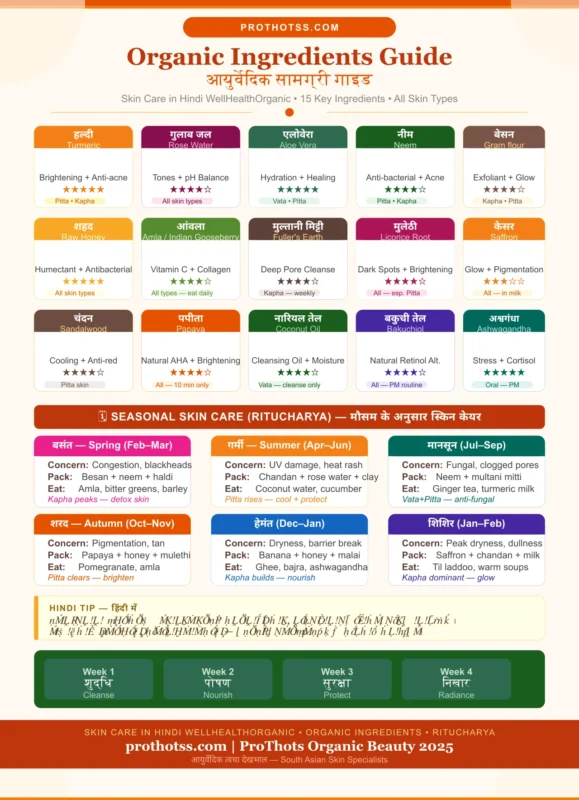
2. How the Core Ingredients Actually Work
| Ingredient | Hindi | Active Compound | What It Does | Evidence |
|---|---|---|---|---|
| Turmeric | हल्दी | Curcumin | Anti-inflammatory; inhibits tyrosinase (reduces melanin production) | Well studied for anti-inflammatory and skin-brightening effects |
| Aloe Vera | घृतकुमारी | Acemannan, glucomannan | Hydrates; supports wound healing | Widely supported in dermatology literature |
| Neem | नीम | Nimbin, nimbidin | Antibacterial and antifungal | Strong traditional use, growing clinical interest |
| Rose Water | गुलाब जल | Phenylethanol | Mild astringent, pH-balancing | Commonly used, limited large-scale trials |
| Besan (gram flour) | बेसन | Saponins, zinc | Gentle surfactant, mild oil control | Traditional use; zinc’s antibacterial role is well established |
| Raw Honey | शहद | Enzymatic H₂O₂, humectants | Mild antibacterial, moisturising | Supported by multiple small studies |
| Amla | आंवला | Vitamin C (stable form) | Antioxidant, supports collagen synthesis | Strong evidence for vitamin C’s role in skin health |
| Mulethi (licorice) | मुलेठी | Glabridin | Inhibits melanin production | Several clinical comparisons against standard brighteners |
| Multani Mitti | मुल्तानी मिट्टी | Clay minerals | Oil absorption | Traditional; supported by basic clay chemistry |
We’ve kept the specific-sounding “study found X%” claims out of this table — where real numbers matter for a decision (like drug interactions or medical timelines), see a dermatologist rather than relying on any blog’s summary of a single study.
3. Five Ayurvedic Face Packs (with Exact Method)
Haldi-Besan-Doodh Pack — Brightening
Ingredients: 1 tbsp besan, ¼ tsp raw turmeric, 1 tsp raw honey, 2 tbsp full-fat milk Method: Mix to a smooth paste, apply to clean skin, leave 15–20 minutes, rinse with lukewarm water using gentle circular motion. Frequency: 2–3x weekly. हिंदी: बेसन, हल्दी, शहद और दूध मिलाकर पेस्ट बनाएं। 15-20 मिनट लगाकर धोएं। सप्ताह में 3 बार।
Neem-Multani Pack — Oil Control & Acne
Ingredients: 1 tbsp neem powder, 1 tbsp multani mitti, rose water to bind Method: Apply to affected areas only, leave exactly 10 minutes, rinse thoroughly. Follow with a light moisturiser. Frequency: Once weekly — more frequent use damages the skin barrier. ⚠ Caution: Never exceed 12 minutes contact time.
Kesar-Chandan-Doodh Pack — Radiance
Ingredients: 4–5 saffron strands soaked overnight in milk, ½ tsp sandalwood powder, ½ tsp mulethi powder Method: Apply for 20 minutes, rinse with cool water. Good for pre-event use, 3x weekly for 3 weeks.
Papaya Enzyme Pack — Gentle Exfoliation
Ingredients: 2 tbsp raw (unripe) papaya pulp, ½ tsp turmeric, 1 tsp honey Method: Apply avoiding the eye area, leave 10–12 minutes only, rinse thoroughly. Once weekly maximum — the papain enzyme over-exfoliates with longer contact.
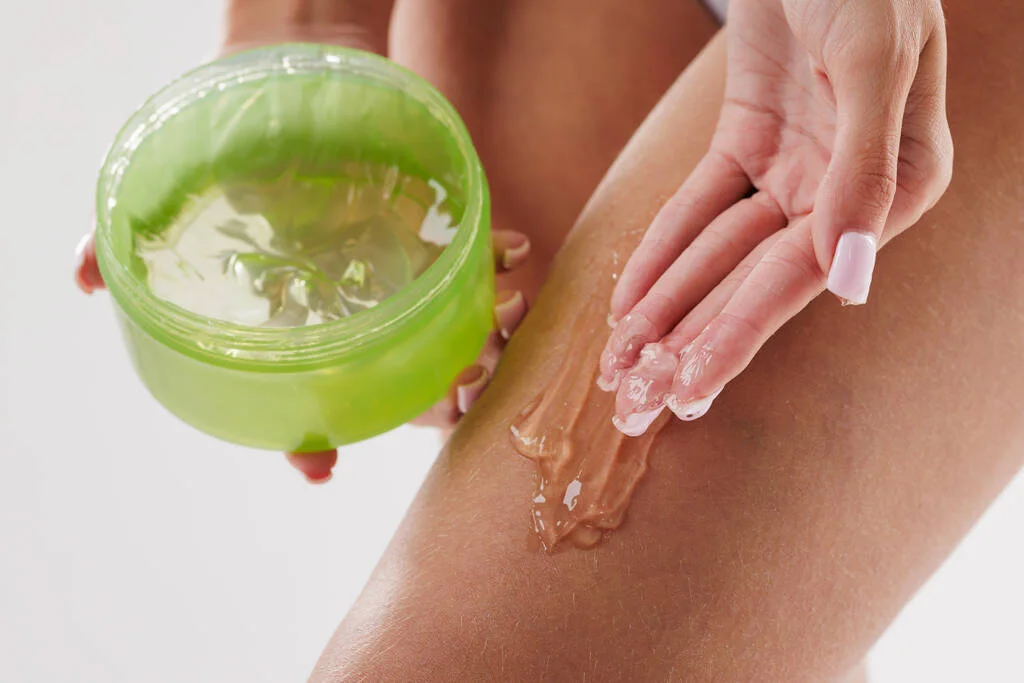
Aloe-Rose Water Toner — Daily Hydration
Ingredients: 3 tbsp rose water, 1 tbsp fresh aloe vera gel, 3 drops glycerin (optional) Method: Mix in a spray bottle, apply after cleansing. Refrigerate; use within 3 days (add a drop of vitamin E oil to extend shelf life slightly).
These five cover the most common needs — brightening, oil control, radiance, gentle exfoliation, and daily toning. Rotate based on what your skin needs that week rather than using all five.
4. Daily Routine by Skin Type
The most common question we get isn’t “what should I use” — it’s “in what order.” Here’s how we’d lay it out for each skin type:
| Time | Step | Dry (Vata) | Sensitive (Pitta) | Oily (Kapha) |
|---|---|---|---|---|
| Morning | Cleanse | Raw cold milk on cotton | Rose water, no friction | Besan + water, gentle wash |
| Morning | Tone | Rose water + glycerin | Chilled green tea | Rose water only |
| Morning | Moisturise | Almond oil, few drops | Aloe vera gel, thin layer | Lightweight gel or skip |
| Morning | SPF | Mineral SPF 30–50 | Mineral SPF 50 | Mineral SPF 30, non-comedogenic |
| Evening | Double cleanse | Coconut oil → raw milk | Almond oil → rose water | Jojoba oil → besan wash |
| Night | Nourish | Sesame oil | Sandalwood/chamomile oil | Aloe vera gel only |
हिंदी सारांश: सुबह — सफाई, टोनर, मॉइस्चराइजर, सनस्क्रीन। शाम — डबल क्लेंज़ और स्पॉट ट्रीटमेंट। रात — पोषण तेल।
5. Seasonal Skin Care (Ritucharya)
Ayurveda treats skin needs as season-dependent, not fixed year-round:
| Season | Months | Main Challenge | Weekly Pack | Moisturiser |
|---|---|---|---|---|
| Spring | Feb–Mar | Congestion, dullness | Papaya enzyme | Light aloe gel |
| Summer | Apr–Jun | UV damage, oiliness | Sandalwood-multani | Aloe gel only |
| Monsoon | Jul–Sep | Fungal risk, clogged pores | Neem-multani | Light rose mist |
| Autumn | Oct–Nov | Post-monsoon pigmentation | Haldi-besan-doodh | Light almond oil |
| Early Winter | Nov–Dec | Barrier weakening | Banana-honey-malai | Almond/sesame oil |
| Deep Winter | Jan–Feb | Peak dryness | Kesar-chandan-doodh | Sesame oil + shea |
6. Common Mistakes
One pattern shows up again and again: someone’s skin is dry and flaking, so they exfoliate more — which strips it further and makes the flaking worse, so they exfoliate again. By the time we hear about it, the skin barrier is genuinely damaged and it takes weeks of doing less to recover, not more. If that sounds familiar, the table below is probably why.
| Mistake | Why It Hurts | Fix |
|---|---|---|
| Daily besan scrubbing | Disrupts the skin barrier, increases sensitivity | Limit to 2x weekly as an exfoliant |
| Leaving turmeric on too long | Can stain skin, and prolonged contact may irritate | Cap at 20 minutes, always mixed with honey/milk |
| Skipping patch tests | “Natural” doesn’t mean non-irritating — even amla or rose water can cause reactions in some people | Patch-test on the inner arm for 24 hours first |
| Expecting results in a week | Skin cell turnover and collagen remodelling take weeks | Commit to 30 days minimum before judging results |
| Undiluted lemon juice on skin | pH of 2–3 vs. skin’s ideal 4.5–5.5; risk of phytophotodermatitis in sunlight | Dilute 1:4 with rose water, never go outdoors with it on |
| Coconut oil on oily/acne-prone face | Comedogenic rating of 4/5 — can worsen breakouts | Use on body/hair; choose jojoba or rosehip oil for oily faces |
| Skipping moisturiser because skin is oily | Skipping it can push oily skin to produce more oil to compensate for the dehydration | Use a lightweight, oil-free gel moisturiser — even on oily skin, every day |
7. Myths vs. Reality
| Myth | Reality |
|---|---|
| “Expensive products work better” | Price doesn’t determine effectiveness — a well-formulated affordable product can outperform an expensive one with the wrong ingredients for your skin. |
| “Natural means safe” | Natural ingredients can still cause reactions — poison ivy is natural too. Always patch-test. |
| “You can shrink your pores” | Pore size is largely genetic. Products can make pores look smaller temporarily; nothing shrinks them permanently. |
| “Oily skin doesn’t need moisturiser” | All skin types need hydration, oily included — see the mistake above. |
| “Darker skin doesn’t need sunscreen” | Everyone needs sun protection regardless of skin tone; melanin offers some protection but not enough on its own. |
8. When to See a Dermatologist
Home remedies and routine adjustments handle most day-to-day skin concerns — but some things need a professional, not a face pack. See a dermatologist if you notice:
Right away: – A sudden, severe rash or hives – Painful, deep (cystic) acne – Signs of infection — pus, warmth, spreading redness – A severe allergic reaction or burning sensation
If it persists: – Acne that hasn’t improved after 6–8 weeks of a consistent routine – Dark spots that keep getting darker instead of fading – Any mole or growth that’s changing in size, shape, or colour – Persistent itching or scaling that home care doesn’t touch
Ayurvedic and home-based skincare works well for maintenance, mild concerns, and prevention — it isn’t a substitute for medical care when something looks or feels wrong. If in doubt, get it checked; it’s rarely a wasted visit.
9. Frequently Asked Questions
These are the questions we’re asked most often — answered the way we’d answer them in person.
What is Ayurvedic skin care in Hindi, in simple terms? It’s daily skincare using Ayurvedic principles and kitchen ingredients — turmeric, neem, aloe vera, rose water, besan — combined with seasonal adjustment and attention to overall (not just topical) skin health, explained in Hindi.
How often should I use a face pack? Most packs: 1–3 times weekly, not daily. Over-use of even natural ingredients can damage the skin barrier.
Is lemon safe on the face? Not undiluted. Its low pH disrupts the skin’s acid mantle and creates a phototoxic burn risk in sunlight. Dilute heavily if you use it, and skip sun exposure afterward.
How long before I see results? Dehydration/dullness: 1–2 weeks. Acne improvement with dietary change: 3–6 weeks. Dark spot fading: 6–12 weeks, since melanin breakdown is slow. Give any routine at least 30 days before judging it.
Can I do this with sensitive skin? Yes, with modifications: skip lemon and tomato, use aloe vera as your main moisturiser, limit pack frequency to once weekly, and always patch-test first.
This article was written and reviewed by the ProThots Editorial Team. It draws on published dermatology and Ayurveda research; where a specific clinical figure is cited, it links to the source. This is general information, not a substitute for advice from a dermatologist or licensed Ayurvedic practitioner — particularly if you have a diagnosed skin condition or are pregnant.

The ProThots editorial team researches and writes evidence-based content on health, beauty, wellness, and lifestyle